|
||||||||
|
||||||||





 About
JTFA About
JTFA |
An overview of the Japan
Textile Finishers' Association and the industry to which it belongs |
1.An overview of the Japan Textile Finishers' Association (as of July 1, 2026)
1) Established in June 1969
2) Members: 36 including 27 firms and 9 organizations (which include 171 firms)
3) Board of Directors: 12 Board members and 2 Auditors
4) President: Y.Washi (Managing Director, Tokai Senko K.K., Aichi)
| Vice-President: | H.Sasaki (Chairman of the Board, KOMATSU MATERE Co., Ltd., Ishikawa) | ||
| Vice-President: | K.Goto (President, GISEN CO., LTD., Gifu) | ||
| Vice-President: | Y.Takagaki (President, WAKAYAMA SENKO Co., Ltd., Wakayama) | ||
| Vice-President: | I.Yamauchi (Executive Officer, Kurabo Industries Ltd., Osaka) |
5) Office address:
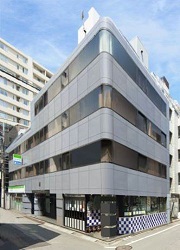 Tokyo Office (Kanda Ocean Building) (Click photo for map) |
 |
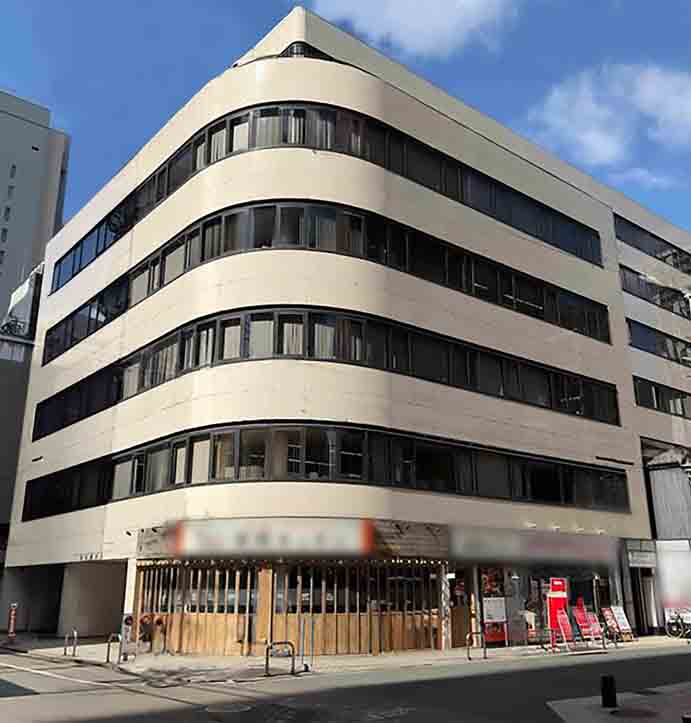 Osaka Office (Honmaruta Building) (Click photo for map) |
| Kanda Ocean Building 2F 1-15-2 Uchikanda Chiyoda-ku Tokyo 101-0047 Director: Mr.T.Jingu Tel:+81-3-5577-6876 Fax:+81-3-5577-6877 Email:nisen.tokyo@moon.email.ne.jp |
Honmaruta Building 5F 3-4-5 Azuchimachi Chuo-ku Osaka 541-0052 Director: Mr.N.Ohshima Tel:+81-6-4963-2315 Fax:+81-6-4963-2319 Email:nisen.osk@moon.email.ne.jp |
2.An Overview of the Industry
1)Our industry constitutes the dyeing and finishing (covering mechanical dyeing and hand dyeing) of yarn and woven and knitted fabrics.
| Number of firms | Number of employees | Output value (¥100millions) |
Major locations | |
| Mechanical dyeing of woven and knitted fabrics of cotton, staple fiber and linen | 86 | 2,837 | 529 | Shizuoka, Aichi, Kyoto, Osaka, Wakayama, etc |
| Mechanical dyeing of woven and knitted fabrics of silk and artificial silk | 70 | 4,096 | 955 | Fukui, Ishikawa, Toyama, Niigata, etc |
| Finishing of woven and knitted fabrics | 70 | 1,435 | 168 | Ryomo region (Gunma and Tochigi), Shizuoka, Hyogo, etc |
| Hand dyeing and finishing of woven and knitted fabrics | 311 | 2,516 | 192 | Tokyo, Kanagawa, Shizuoka, Kyoto, etc |
| Finishing of woven and knitted fabrics and lace | 74 | 2,422 | 384 | Ryomo region(Gunma and Ibaraki), Hokuriku region (Toyama, Ishikawa, Fukui, and Niigata), Osaka, etc |
2) Features of the Industry
| - | Brings together knowledge from a wide range of fields including physics, chemistry, electronics and design, and heightens the added-value of textile products by raising their functionality. |
| - | Majority of business transactions are conducted under a commission basis("Itaku"). |
| - | Consists of those firms ranging from small-scale manual and mechanical enterprises to some large mechanical dyeing enterprises. |
| - | Consumes a large amount of water, energy and chemicals. |
| - | Requires antipollution measures. |
3) Trends in mechanical processing volume and value.
| Item | Trends in processing volume (millions of m2) |
Trends in processing value (¥100millions) |
||||
| Year | Total | Year-on-year | Filament | Staple Fiber | Total | Year-on-year |
| 2020 | 1,514 | 85.9 | 601 | 567 | 1,346 | 81.2 |
| 2021 | 1,555 | 102.7 | 619 | 557 | 1,416 | 105.2 |
| 2022 | 1,552 | 99.9 | 606 | 558 | 1,500 | 105.9 |
| 2023 | 1,548 | 99.7 | 610 | 548 | 1,560 | 104.0 |
| 2024 | 1,462 | 94.4 | 593 | 516 | 1,544 | 99.0 |
| 2025 | 1,417 | 96.9 | 587 | 495 | 1,559 | 101.0 |
(Source: Textile Statistics, METI)
